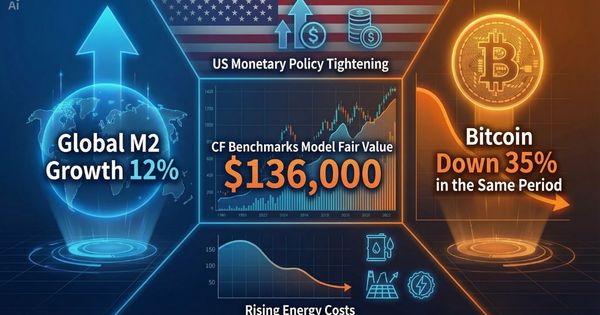
Since mid-2025, global M2 money supply has grown by about 12%, while Bitcoin has fallen by roughly 35% over the same period—marking one of the largest decouplings on record.
According to the CF Benchmarks model, based on historical liquidity relationships, Bitcoin’s “fair value” is around $136,000, creating a wide gap versus the current price near $70,000. Analysts say the key drivers behind this decoupling are U.S. monetary tightening and rising energy costs.
Join the CFTime Telegram (TG) Discussion Group!
Want to stay on top of the latest crypto market updates and AI news & insights? Get access to free Web3 entry passes anytime—join CFTime’s TG community now!
Bitcoin Liquidity Decoupling: Is the M2–Bitcoin Link Temporary?
CF Benchmarks’ research director Gabe Selby said:
“The key takeaway from more than a decade of data is that historical decoupling between M2 and Bitcoin has always been temporary.”
Even though the current gap is significant, past experience suggests that Bitcoin often catches up to liquidity trends over multiple quarters.
The Missing Link: U.S. Monetary Tightening
Despite global liquidity expansion, the Federal Reserve’s tightening stance restricts capital flows into risk assets. The Fed’s balance sheet has shrunk from a peak of nearly $9 trillion in 2022 to about $6.7 trillion, and with interest rates staying high, financial conditions remain tight.
As a result, Bitcoin is more closely tied to real interest rates and overall risk sentiment, rather than nominal money supply growth.
Energy Costs: Rising Gas Prices Erode Household Cash Flow
Economists estimate that since late February, an increase of 81 U.S. cents in gas prices may add about $740 per household per year in spending. This partially offsets the expected rise in tax refunds under the Trump administration’s “Tax Relief for Working Families Act”—projected to increase average refunds by around $1,000.
Rising oil prices are also linked to ongoing tensions disrupting global oil supply lines—especially the Hormuz Strait. Oil prices briefly topped $100 before later pulling back to around $92.
The Fed’s Stance: Rates Held Steady, Balancing Inflation and Jobs
On Wednesday, the Federal Reserve kept the target range for the federal funds rate unchanged at 3.50%–3.75%, continuing the pause that began in January. With energy costs intensifying inflation pressures, the Fed remains cautious about easing.
Structural Demand: ETFs and Corporate Treasury Support
Selby added that:
“Through traditional financial channels—namely U.S. spot Bitcoin ETFs and corporate treasuries—demand is returning, providing more direct and more mechanical support for a potential trend reversal.”
This kind of sustained buying from these groups has become a structural demand source that didn’t exist in earlier cycles.
Conclusion: Wait for Catalysts to Repair the Decoupling
The decoupling between Bitcoin and global liquidity reflects how the current macro environment is different: U.S. tightening and higher energy costs are jointly suppressing liquidity transmission into risk assets. However, historical patterns suggest this decoupling is temporary.
Catalysts that could “repair” the spread may come from two directions:
- a shift in Fed policy (rate cuts or a slower pace of balance sheet reduction), and
- continued buying pressure through traditional channels (ETFs and corporate treasuries).
Until then, Bitcoin’s price is likely to continue navigating the tug-of-war between liquidity expansion and policy tightening.
A $136,000 “fair value” is both the model’s target and an implicit bet on future policy turning points.