
A Comprehensive Analysis of the Ethereum Fusaka Upgrade

Ethereum plans to deploy its Fusaka upgrade on December 3, aimed at enhancing rollup scalability, node efficiency, and wallet functionalities. The focus is not on flashy new features but on strengthening the underlying infrastructure. The core of this upgrade comes from EIP-7594, which introduces peer data availability sampling, allowing nodes to verify blob data by sampling small chunks from peer nodes without needing to download the entire dataset.
This architecture reduces bandwidth requirements while maintaining security, enabling Ethereum to increase blob capacity without requiring validators to run data center-level infrastructure. For layer two networks, lower data costs directly translate to reduced transaction fees for end users, ensuring stability even during periods of high network congestion.
Fusaka Upgrade: Blob Capacity Expansion and Block Size Changes
The Fusaka upgrade will trigger a series of small forks limited to blob parameters, scheduled to take place immediately after the mainnet deployment. BPO1 will occur on December 9, raising the blob target from 6 to 10 and the maximum from 9 to 15. Subsequently, BPO2 on January 7 will push the target to 14, with a maximum of 21. This configuration-only approach allows for rapid capacity expansion without a full hard fork, enabling the network to monitor performance and stability during the gradual increase.
Additionally, EIP-7935 will raise the default block gas limit to 60 million, further expanding the throughput for legitimate use. EIP-7825 sets the limit for a single transaction at 16,777,216 gas, preventing a single operation from monopolizing an entire block. This dual implementation increases network capacity while closing denial-of-service vulnerabilities, paving the way for parallel processing of future transactions.
Ethereum Upgrade: Blob Fee Market Stability and Network Protocol Cleanup
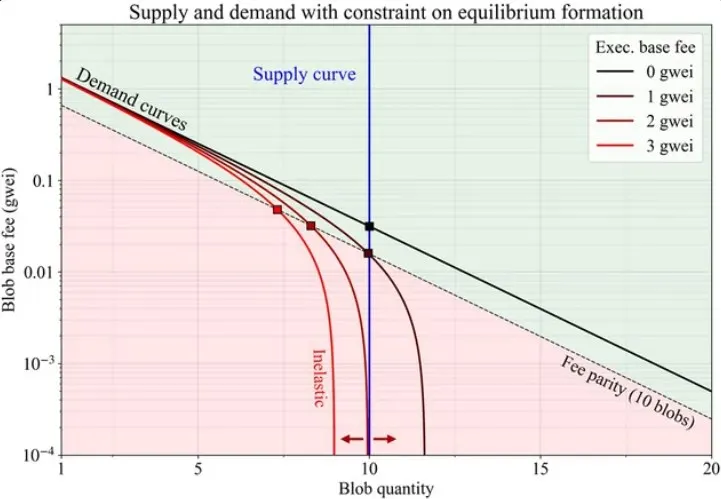
EIP-7918 links the base fee for blobs to execution layer costs, preventing extreme price fluctuations during early implementations, thus avoiding crashes to zero or surges unaffected by layer one network conditions. This allows rollup operators to achieve a more predictable cost structure for planning and budgeting, leading to a better user experience with fewer inexplicable low prices or excessively high blob release days.
EIP-7642 introduces eth/69, simplifying the peer-to-peer protocol by removing legacy elements from the proof-of-work era and receipt bloom. This streamlined gossip layer will reduce bandwidth consumption and simplify client implementation. Combined with PeerDAS, this cleanup lowers resource demands for synchronizing validators and full node operators.
Ethereum Upgrade: Hard Block Size Limit and Validator Coordination Improvements
EIP-7934 sets a hard RLP execution limit on block size, preventing blocks from expanding to unmanageable byte sizes under an attacker maximizing gas usage, thus safeguarding performance in hostile environments.
EIP-7917 standardizes deterministic proposer foresight, clarifying the network's ability to anticipate upcoming block proposers. This predictability benefits layer two sequencers, bridging operators, and MEV infrastructure, allowing for better coordination of pre-confirmation and reducing uncertainty in proposer duty assignments.
Wallet and Developer Tools
EIP-7951 adds native support for secp256r1 precompiles, aligning with security enclaves on iPhone and Android as well as WebAuthn keys. This implementation simplifies wallet building and hardware-backed authentication, eliminating the need for workarounds.
EIP-7939 introduces an opcode for counting leading zeros, providing gas savings for zero-knowledge circuits, compression algorithms, and low-level mathematical operations. EIP-7910 enables tools to query fork and configuration data directly from nodes via eth_config, removing the need for guesswork regarding upgrade parameters.
Ethereum Upgrade: Cryptographic Operation Repricing and Home Staking Advantages
EIP-7883 and EIP-7823 refine the pricing of ModExp precompiles, tightening ranges and increasing costs for large exponentiation calculations. These adjustments close attack vectors that could delay block processing due to low-cost operations while establishing accurate pricing for computationally expensive cryptographic functions.
The combined effects of PeerDAS bandwidth reduction, eth/69 protocol cleanup, transaction limits, and block size restrictions lower the hardware and connectivity requirements for full nodes and validator operations. These reduced thresholds support decentralization, allowing home staking to remain economically viable without enterprise-grade infrastructure.
The Fusaka upgrade enables Ethereum to handle significantly higher rollup throughput and layer one transaction volumes. This upgrade provides expanded blob capacity, refined fee markets, clearer network protocols, and improved developer tools without introducing flashy consumer-facing features.
The deployment on December 3 marks a reinforcement of the infrastructure, aimed at supporting long-term scalability as blockchain adoption surpasses the current user base.




